

Bladder leaks affect more than 25 million Americans, yet most people only ever hear one piece of advice: "Do your Kegels." While Kegel exercises are a legitimate starting point, they're just one piece of a much bigger puzzle. The pelvic floor exercises for incontinence that actually move the needle go beyond simple squeezes — and this guide breaks down five of the most effective ones, exactly how to do them, and why they work.
Why Pelvic Floor Training Is More Than Just Kegels
Your pelvic floor is a hammock-shaped group of muscles that supports your bladder, bowel, and uterus (or prostate). When those muscles are weak, too tight, or poorly coordinated, leaks happen — during a sneeze, a sprint, or even just standing up. According to the National Institutes of Health (NIH), urinary incontinence is one of the most prevalent — yet undertreated — conditions in adults of all ages.
Here's something many active people are surprised to learn: being physically fit doesn't automatically mean your pelvic floor is strong. You can run marathons, deadlift twice your body weight, and still experience stress incontinence. That's because the pelvic floor is a specialized muscle group that requires targeted, intentional training — just like any other muscle. The American Urogynecologic Society (AUGS) recommends performing pelvic floor muscle training three times per day for the best long-term outcomes. That's three short sessions — not three hours — and the five exercises below fit perfectly into that structure.

One more thing before we dive in: while you build strength, it's completely reasonable to want reliable, dignified protection. Many people use Orykas washable incontinence underwear during this process — not as a substitute for exercise, but as a confidence booster that lets them stay active and consistent with their training.
1. Kegel Contractions (Done Right This Time)
Yes, Kegels made the list — but the reason so many people don't see results is that they're doing them incorrectly. A proper Kegel is not about squeezing your glutes, tightening your abs, or holding your breath. It's a specific lift-and-hold of the pelvic floor muscles themselves. Think of it as gently picking up a blueberry with your vagina or pulling your perineum upward — not clenching downward.
To do a correct Kegel: lie on your back or sit comfortably. Contract only your pelvic floor muscles and hold for 3–5 seconds, then fully release for the same amount of time. That release is just as important as the contraction — an overly tight pelvic floor is also a dysfunctional one. Work up to holding for 10 seconds over several weeks. The Mayo Clinic recommends aiming for 3 sets of 10 repetitions daily, which lines up perfectly with AUGS's three-times-per-day guidance.
Quick troubleshooting tip: if you're unsure whether you're contracting the right muscles, try stopping your urine stream mid-flow once or twice (not as a regular habit — just to identify the muscles). If you feel nothing, or if every surrounding muscle tightens instead, consider working with a pelvic floor physical therapist, who can provide biofeedback-guided training for precise results.
2. Glute Bridge
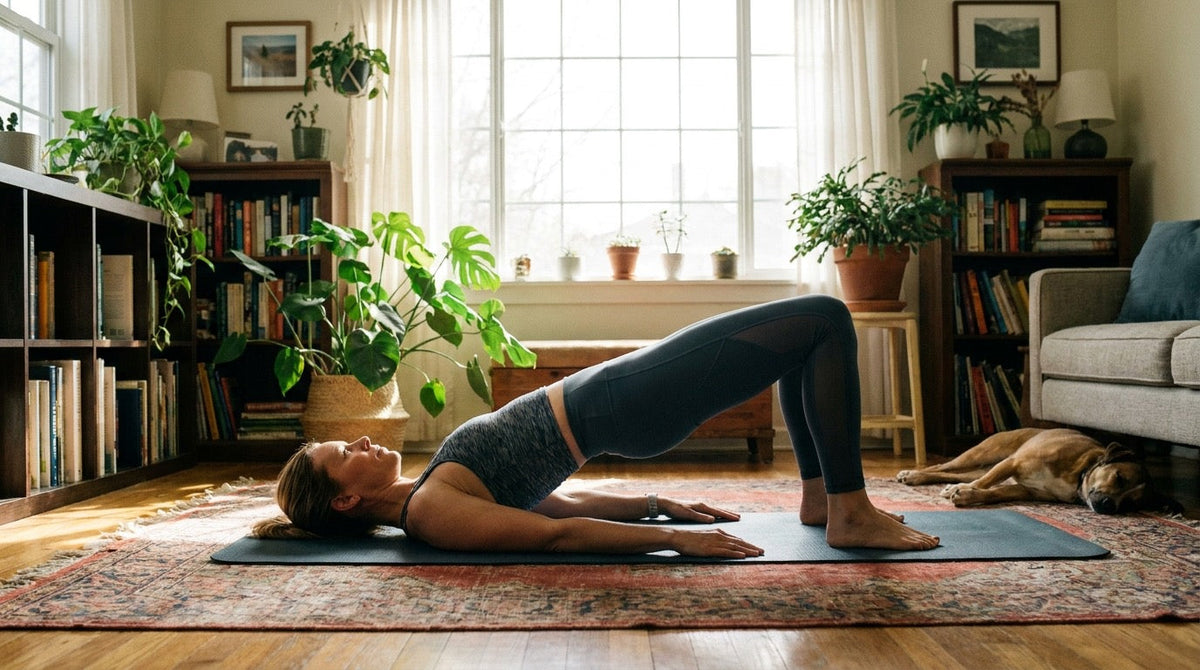
The glute bridge is one of the most underrated exercises for bladder control, and it targets far more than your glutes. When you lift your hips into a bridge position, you simultaneously activate your glutes, hamstrings, lower back, and — critically — your pelvic floor. These muscles work as a unit, and training them together builds the kind of integrated, functional strength that translates to real-world leak prevention.
To perform a glute bridge: lie on your back with your knees bent and feet flat on the floor, hip-width apart. Inhale to prepare, then exhale as you gently contract your pelvic floor and press through your heels to lift your hips toward the ceiling. Hold at the top for 2–3 seconds, maintaining a neutral spine (no hyperextending your lower back), then slowly lower back down. That's one rep. Aim for 3 sets of 10–12 reps.
The key here is timing the pelvic floor engagement with your exhale on the way up — a technique known as the "core-breath connection." This pattern mirrors what your body needs to do naturally when you cough, sneeze, or lift something heavy. Research published through the NIH's National Library of Medicine confirms that multi-muscle functional training improves pelvic floor coordination significantly more than isolated contractions alone.

3. Squat
If the glute bridge is underrated, the squat is wildly misunderstood in the context of pelvic health. Many people with incontinence avoid squats because they fear leaking during the movement. Here's the reframe: a properly performed squat, done with intentional pelvic floor engagement, is one of the most powerful exercises for long-term bladder control. It trains your pelvic floor to manage intra-abdominal pressure — the exact force responsible for stress leaks.
Stand with your feet shoulder-width apart and toes slightly turned out. As you inhale and lower into the squat, allow your pelvic floor to gently lengthen and relax (this is eccentric loading — important and often skipped). As you exhale and drive back up, contract your pelvic floor before you reach full standing. This deliberate timing — relax on the way down, engage on the way up — teaches your pelvic floor to respond reflexively to load, just like it should during everyday activities.
Start with bodyweight squats before adding any resistance. If you notice leaking during the descent, focus more on the inhale-and-release technique, and consider shortening your range of motion temporarily. According to the National Association for Continence (NAFC), lifestyle-integrated strength exercises like squats significantly improve outcomes in people with mild to moderate stress urinary incontinence when combined with structured pelvic floor training.
4. Bird-Dog
The bird-dog is a stability exercise borrowed from physical therapy and core rehabilitation, and it's exceptional for pelvic floor training because it challenges your deep core — including the transverse abdominis and multifidus muscles that work hand-in-hand with your pelvic floor. Training these muscles together improves both control and endurance, which matters most when you're on hour three of a long day or a long run.
Start on all fours with your wrists directly under your shoulders and knees under your hips. Your spine should be in a neutral position — not arched or rounded. Exhale gently and engage your pelvic floor, then slowly extend your right arm forward and your left leg back simultaneously. Hold for 3–5 seconds while breathing steadily, then return to the starting position with control. Alternate sides for 10 reps each. That counts as one set — aim for 3 sets per session.
The bird-dog earns its place here because it demands coordination, not just strength. Your brain has to learn to stabilize the spine and pelvis dynamically while your limbs are moving — which is exactly what your body needs to handle unpredictable movements without leaking. It's also completely low-impact, making it accessible for people of virtually all fitness levels, including those managing back pain or recovering postpartum.
5. Clamshell
This one surprises people. The clamshell primarily targets the hip abductors — specifically the gluteus medius — but its role in pelvic floor health is direct and significant. Weak hip abductors alter your pelvic alignment and create compensatory patterns that put excess strain on the pelvic floor muscles. Strengthening the hips stabilizes the entire pelvis, giving your pelvic floor a better structural foundation to work from.
To do a clamshell: lie on your side with your knees bent at roughly a 45-degree angle and your hips stacked. Keep your feet together and your pelvis neutral (don't let it roll back). Gently engage your pelvic floor, then lift your top knee as high as you comfortably can without rotating your hips — like a clamshell opening. Hold for 2 seconds at the top, then lower slowly. Do 15 reps on each side for 3 sets. You can add a resistance band around your thighs to increase the challenge as you get stronger.
Pelvic floor physical therapists frequently prescribe clamshells to patients with incontinence alongside Kegels because the hip-pelvis-pelvic floor connection is that important. The American Urological Association (AUA) acknowledges that pelvic floor muscle training, when it addresses surrounding musculature and not just isolated contractions, yields stronger and more durable clinical outcomes for both stress and urge incontinence.

The "I'm Already Fit" Misconception — Addressed Directly
Let's be completely clear: athletic fitness and pelvic floor fitness are not the same thing. Elite female athletes — including Olympic runners and CrossFit competitors — report urinary incontinence at rates as high as 28–80% depending on sport, according to research cited by the CDC and published in sports medicine literature. High-impact training, heavy lifting, and repetitive core-bracing patterns can actually contribute to pelvic floor dysfunction if the foundational coordination isn't there.
If you're fit and still leaking, the problem isn't effort — it's specificity. Your training hasn't been specific to your pelvic floor's unique demands. That's not a character flaw; it's a gap that the five exercises above are designed to fill. Add them to your current routine three times per day, as AUGS recommends, and give it at least 6–8 weeks of consistent effort before evaluating results. Pelvic floor retraining is a process, not an overnight fix.
During that process — and honestly, beyond it — having protection you trust makes it easier to stay active and engaged. Orykas makes washable, reusable incontinence underwear designed for real life: discreet enough for a workout, durable enough for daily use, and sustainable enough to replace disposables long-term.
Key Takeaways
- Pelvic floor training works best when it goes beyond Kegels to include functional, multi-muscle exercises like bridges, squats, bird-dogs, and clamshells.
- AUGS recommends 3 training sessions per day for optimal pelvic floor rehabilitation outcomes.
- Being physically fit doesn't protect you from incontinence — pelvic floor coordination requires specific, intentional training.
- Timing matters: engage your pelvic floor on the exhale during exertion, and practice relaxing it just as much as contracting it.
- Consistency over 6–8 weeks is the minimum commitment needed to see meaningful improvement.
- If you're unsure whether you're engaging the right muscles, a pelvic floor physical therapist is the most direct path to better results.
Frequently Asked Questions
How long does it take for pelvic floor exercises to stop bladder leaks?
Most people begin to notice improvement in bladder control within 6–8 weeks of consistent pelvic floor training, though significant changes often take 3–6 months. According to the Mayo Clinic, daily practice (ideally three sessions per day as recommended by AUGS) is essential for measurable results. Individual timelines vary depending on the severity of incontinence, whether you're working with a pelvic floor physical therapist, and how consistently you're training.
Can pelvic floor exercises fix stress incontinence completely?
For many people, yes — particularly those with mild to moderate stress urinary incontinence. The American Urological Association (AUA) lists pelvic floor muscle training as a first-line treatment for stress incontinence, and multiple clinical studies show significant reduction or elimination of leaks with structured programs. Results depend on the cause and severity of incontinence; a healthcare provider can help determine whether exercise alone is sufficient or whether additional interventions are appropriate.
Is it possible to overdo pelvic floor exercises?
Yes. Over-training your pelvic floor can lead to hypertonia — a state where the muscles are too tight to function properly. An overly tense pelvic floor can cause pain, incomplete bladder emptying, and paradoxically, more leaking. This is why the release phase of every Kegel is as important as the contraction. If you experience pelvic pain, increased urgency, or worsening symptoms, stop and consult a pelvic floor physical therapist before continuing.
Do pelvic floor exercises work for urge incontinence as well as stress incontinence?
Yes, though the mechanism is slightly different. For urge incontinence (the sudden, intense need to urinate), pelvic floor exercises help by giving you a voluntary "override" signal — contracting the muscles firmly when an urge hits can suppress the bladder's contraction reflex. The National Association for Continence (NAFC) supports pelvic floor training as an effective behavioral strategy for both stress and urge incontinence, as well as mixed incontinence that involves both.
Do men benefit from pelvic floor exercises for incontinence?
Absolutely. Men — particularly those who have undergone prostate surgery — frequently experience urinary incontinence, and pelvic floor muscle training is a standard post-surgical rehabilitation recommendation. The NIH and AUA both recognize pelvic floor exercises as effective for male incontinence, and the same principles (Kegels, bridges, squats, bird-dogs, and clamshells) apply. Men may benefit from working with a pelvic floor physical therapist to ensure correct muscle identification and technique from the start.
Share:
The Complete Guide to Postpartum Incontinence Recovery
Menopause and Bladder Changes: Why It Happens and What Actually Helps