

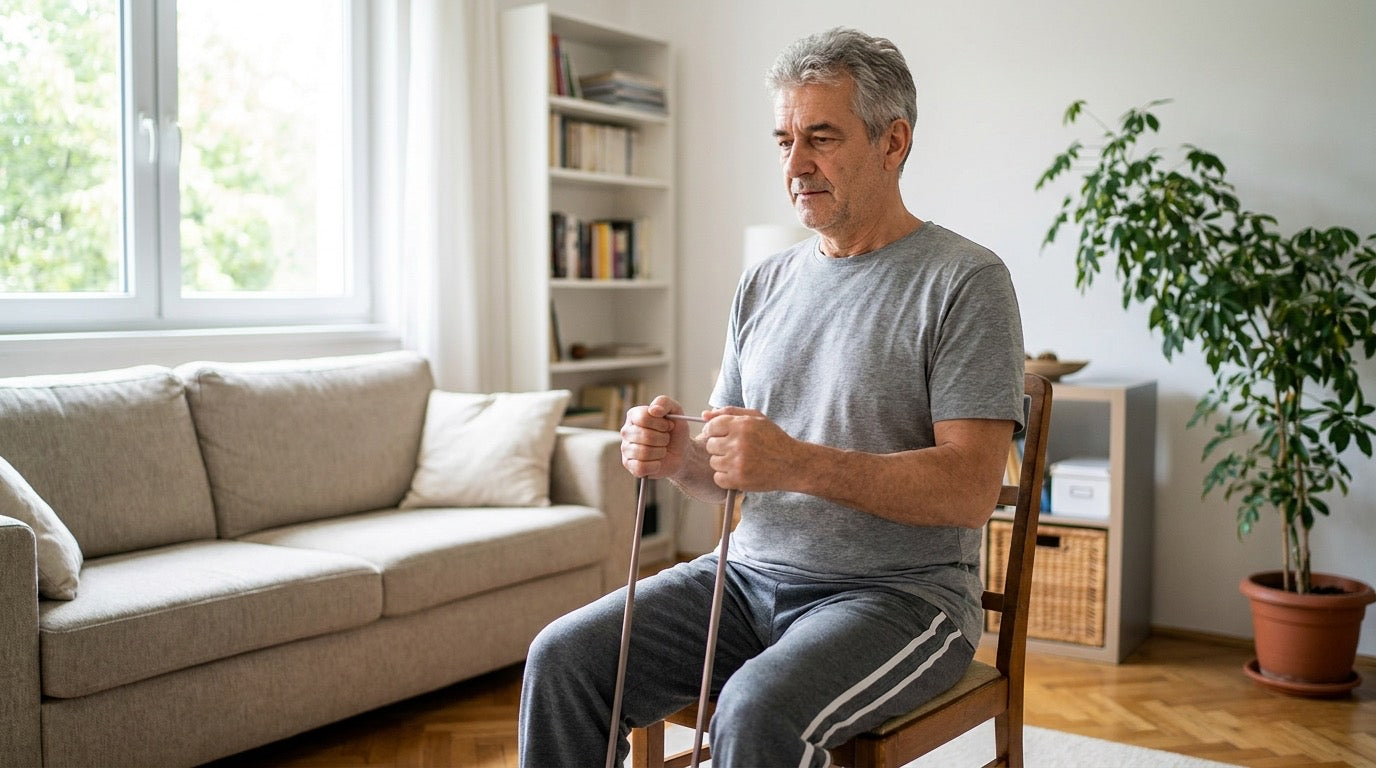
If you've recently had prostate surgery, your doctor or physical therapist has almost certainly told you to start doing Kegel exercises. And for good reason — research published by the National Institutes of Health (NIH) consistently shows that pelvic floor muscle training is one of the most effective tools for regaining urinary control after a radical prostatectomy. But here's the thing: doing Kegels incorrectly can actually slow your recovery — or make leakage worse. Below are the six most common Kegel mistakes men make after prostate surgery, plus exactly what to do instead.
## 1. Bearing Down Instead of Lifting Up
This is the single most common mistake, and it's sneaky because it can feel like you're doing something productive. Bearing down — essentially pushing outward as if you're straining during a bowel movement — activates the wrong set of muscles entirely. Instead of strengthening the pelvic floor, you're actually increasing intra-abdominal pressure and potentially making urinary leakage worse over time.
The correct movement is the opposite: you want to lift and squeeze inward, as if you're trying to stop the flow of urine midstream or prevent passing gas. According to the Mayo Clinic, men should focus on contracting the muscles that run from the tailbone to the pubic bone — the levator ani group — without tightening the abdomen, buttocks, or thighs. If your stomach or backside is visibly tensing, that's a signal you're compensating with the wrong muscles.

A pelvic floor physical therapist (PFPT) can use biofeedback to show you in real time whether you're contracting correctly. Many men are genuinely surprised to learn they've been bearing down for weeks. Getting this foundational movement right is worth every bit of your attention before you build volume or intensity.
## 2. Holding Your Breath During Contractions
It sounds counterintuitive, but holding your breath while doing Kegels is a surprisingly widespread problem — and it works against everything you're trying to accomplish. When you hold your breath, you automatically raise intra-abdominal pressure, which pushes down on the pelvic floor rather than supporting it. Over time, this pattern can contribute to pelvic floor tension and even pelvic pain.
The American Urological Association (AUA) emphasizes that proper breathing coordination is an essential component of effective pelvic floor rehabilitation. The recommended technique is to exhale gently and steadily as you contract, then inhale as you fully release. Think of it as a rhythm: breathe out, lift and squeeze; breathe in, let go completely.
If you notice you're bracing or your neck is tightening, pause and reset. Kegels should feel calm and controlled. You can do them lying down, sitting in a chair, or eventually standing — but in all positions, your breath should be flowing naturally throughout every repetition.
## 3. Skipping the Release Phase
Most men focus so hard on the squeeze that they forget there are actually two equally important parts of a Kegel: the contraction and the complete release. Failing to fully relax the pelvic floor muscles between repetitions is one of the fastest ways to create chronic pelvic tension — a condition that can cause discomfort, urgency, and paradoxically, worse leakage.
A 2020 review in the Journal of Urology found that men who received structured guidance on both the contraction and relaxation phases of pelvic floor training showed significantly better urinary continence outcomes post-prostatectomy than those who did not. The release phase allows the muscles to recover, regain elasticity, and build strength progressively — just the way any other muscle in your body works.
A simple rule of thumb: hold the contraction for the same number of seconds you hold the release. If you squeeze for three seconds, rest for three seconds. As your strength improves, you can gradually work up to longer holds — but always match your release time to your contraction time. Think of it as a balanced conversation between tension and letting go.
## 4. Using the Wrong Muscles Altogether
Many men, especially in the early weeks after surgery, inadvertently recruit their gluteal muscles, inner thighs, or lower abdominals instead of — or in addition to — the pelvic floor. This compensation pattern is extremely common, and it means you're not actually training the muscles responsible for urinary control. You may feel like you're working hard, but the right muscles are getting a free pass.
The National Association for Continence (NAFC) recommends a simple self-check: place one hand lightly on your lower abdomen and the other on your buttock while doing a contraction. If either hand detects significant movement or tightening, you're recruiting accessory muscles. The pelvic floor contraction should feel almost invisible from the outside.
One helpful technique for isolation: try the contraction while seated on a firm chair. Focus specifically on the sensation of lifting the area between your sit bones. If you're still uncertain, this is exactly the kind of problem a pelvic floor physical therapist can diagnose and correct in a session or two. Don't guess — the investment in professional guidance pays enormous dividends in recovery time.
## 5. Overtraining and Doing Too Many Reps
More is not better when it comes to Kegels. This is one of the most well-documented mistakes in pelvic floor rehabilitation. The pelvic floor is a group of muscles, and like any muscle group, it needs rest to adapt and grow stronger. Doing hundreds of Kegels per day — something many men attempt out of sheer motivation — leads to muscle fatigue, increased tension, and in some cases, worsening urinary symptoms.
Research supported by the NIH suggests that for most men recovering from prostatectomy, a structured program of three sets of 10–15 contractions per day is a clinically appropriate starting point. Quality of each contraction matters far more than quantity. A well-executed set of 10 slow, controlled squeezes with full releases is dramatically more effective than 50 rushed, sloppy repetitions.
Listen to your body. If you notice increased urgency, pelvic heaviness, or discomfort after your Kegel sessions, you may be overdoing it. Scale back, rest, and check in with your care team. During this recovery period, many men find that pairing a structured exercise program with reliable, comfortable protection — like Orykas washable incontinence underwear — reduces the stress of accidental leaks so they can focus on building good habits without anxiety.
## 6. Expecting Results Without Consistency Over Time
Perhaps the most discouraging mistake isn't a technique error at all — it's giving up too soon. Recovery after prostate surgery is a process measured in weeks and months, not days. Studies consistently show that men who maintain a consistent pelvic floor training program for three to six months post-surgery experience the most meaningful improvements in continence. Men who stop exercising after a few weeks — often because they don't see immediate results — miss out on the real gains that come with patient, persistent practice.
The Centers for Disease Control and Prevention (CDC) acknowledges that behavioral and rehabilitative interventions for incontinence require sustained effort to be effective. Your nervous system and muscle tissue need time to re-establish the communication pathways that control urinary function — pathways that were disrupted during surgery. There are no shortcuts, but there is a clear, well-worn path forward.
Building Kegels into a daily routine — connected to an existing habit like brushing your teeth, morning coffee, or watching the evening news — makes consistency far easier to maintain. And on the days when leakage feels discouraging, having dependable, dignified protection matters. Orykas incontinence underwear is designed specifically to feel and look like regular underwear, so you can go about your day with confidence while your body continues to heal. The goal is to keep showing up — for your Kegels and for yourself.
Key Takeaways
- Lift, don't push: A correct Kegel contracts inward and upward — never outward or downward.
- Breathe throughout: Exhale on the contraction, inhale on the release. Never hold your breath.
- Release fully: The relaxation phase is just as important as the squeeze — skip it and you risk pelvic tension.
- Isolate correctly: Glutes, thighs, and abs should stay quiet. Only the pelvic floor should be working.
- Quality beats quantity: Three focused sets of 10–15 reps daily outperforms hundreds of careless contractions.
- Stay consistent: Meaningful continence recovery typically takes three to six months of steady practice — keep going.
Frequently Asked Questions
How soon after prostate surgery should I start Kegel exercises?
Most urologists and pelvic floor physical therapists recommend beginning Kegel exercises as soon as the urinary catheter is removed after surgery, typically one to two weeks post-operation. Starting early has been shown in multiple studies to accelerate the return of urinary control. However, always follow your surgeon's specific guidance, since individual surgical approaches and recovery timelines vary. If you're unsure how to begin, a pelvic floor physical therapist can guide your first session safely and effectively.
How long does it take for Kegel exercises to work after prostate surgery?
Most men begin to notice some improvement in urinary control within four to six weeks of consistent, correctly performed Kegel exercises. However, significant and lasting improvement — particularly for men who experienced moderate to severe leakage — typically takes three to six months. Research cited by the NIH shows that men who continue training for six months have meaningfully better continence outcomes than those who stop earlier. Patience and consistency are the most important factors.
How many Kegel reps should men do per day after prostate surgery?
A clinically supported starting point for most men is three sets of 10 to 15 contractions per day, with each contraction held for three to five seconds and followed by an equal-length rest. As pelvic floor strength improves over weeks, duration and hold time can be gradually increased. Avoid the temptation to do more — overtraining fatigued muscles can worsen symptoms rather than improve them. Your pelvic floor PT can customize a progressive program based on your specific recovery.
Can I do Kegel exercises while standing or walking after prostate surgery?
Yes — and eventually, you should. Progressing from lying down to seated to standing to functional positions like walking is an important part of pelvic floor rehabilitation. Gravity adds a natural challenge that strengthens the muscles in the positions where leakage is most likely to occur (during movement and activity). However, start in a lying or seated position while you're learning correct technique. Only add the standing and walking variations once your healthcare provider or pelvic floor PT confirms your form is solid.
Should I see a pelvic floor physical therapist after prostate surgery?
Yes — strongly recommended. The American Urological Association and numerous continence specialists advocate for pelvic floor physical therapy as a first-line treatment for post-prostatectomy urinary incontinence. A trained PFPT can assess whether you're contracting the right muscles, use biofeedback to correct errors in real time, and build a personalized progressive program for your recovery. Many men who struggled with Kegels on their own see rapid improvement after just a few guided sessions. Ask your urologist for a referral — it's one of the most valuable steps you can take.
Share:
What Urologists Want Men to Know About Overactive Bladder
Nocturia in Men: Why You're Waking Up at Night and How to Stop